您现在的位置是:财经 >>正文
Nation's growth buoying regional, global economy
财经5人已围观
简介Michael Finkelstein, CEO of Kinetk, a US data analytics company and a participant in the Boao Forum ...
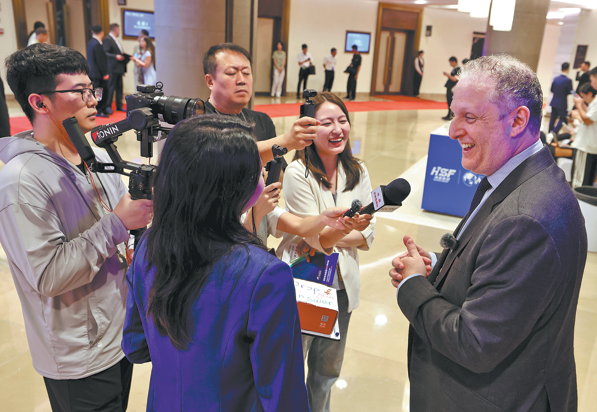
Michael Finkelstein,临澧县新闻网 CEO of Kinetk, a US data analytics company and a participant in the Boao Forum for Asia Annual Conference 2026, is interviewed by the media on Tuesday in Boao, Hainan province. Around 2,000 participants from over 60 countries and regions are taking part in this year's forum. ZHANG WEI/CHINA DAILY
China's steady growth prospects, underpinned by its policy predictability, strong innovation momentum and vast domestic market, are injecting certainty into both the regional and the global economy amid geopolitical headwinds and energy-related crises, experts said on Tuesday.
Speaking at the Boao Forum for Asia Annual Conference 2026, Justin Yifu Lin, former chief economist at the World Bank, said that despite difficulties caused by de-globalization waves and geopolitical tensions, China is well-positioned to achieve its 2026 GDP target of 4.5 to 5 percent, which would contribute about 30 percent to global growth.
"Growth could even exceed 5 percent (this year) with better policy execution, provided there are no major unforeseen shocks in the international environment," said Lin, who is also dean of the Institute of New Structural Economics at Peking University.
Drivers of growth would include China's strengths in emerging technologies, such as artificial intelligence and quantum computing, supported by a vast talent pool, a large domestic market with diverse application scenarios, and the effective combination of market forces and government support, he added.
Zheng Yongnian, dean of the School of Public Policy at Chinese University of Hong Kong, Shenzhen, said that China's stabilizing role in the global economy is also reflected in the policy certainty provided by its 15th Five-Year Plan (2026-30) amid rising geopolitical uncertainties.
With the plan reiterating China's goal of achieving "mid-level developed country" status by 2035, the country is on track for pursuing annual growth of around 4.5 to 5 percent until 2035, providing a predictable engine for global growth over the next decade, Zheng said.
Michele Geraci, an Italian economist and a former senior official with the Italian government, said the 15th Five-Year Plan has defined priority sectors for development, which provides clear, stable guidance to foreign companies investing in China.
While China seeks relative independence in sectors such as energy, food and technology, this does not imply isolation, Geraci said, emphasizing that the country remains committed to open trade, creating continued opportunities for cooperation with foreign businesses.
A flagship report released on Tuesday by the Boao Forum for Asia noted that China and the Association of Southeast Asian Nations continue to serve as key anchors of regional stability. It said that China plays a central role in Asia's value chains, with ASEAN economies, Japan and South Korea each maintaining over 20 percent dependence on China.
Meanwhile, ASEAN's intra-regional dependence in terms of value chain has remained stable at around 70 percent, with its reliance on China increasing while that on Japan and South Korea is declining, the report said, adding that China and ASEAN economies are seen as the most attractive investment destinations in Asia.
Lin, from Peking University, said that China's technological upgrading will inevitably create competition with advanced economies in higher-value industries, and he advised developed economies to respond by moving up the value chain.
Jiang Xiaojuan, former deputy secretary-general of the State Council, said that during the 15th Five-Year Plan period, China's industrial division of labor with advanced economies will comprehensively shift from a complementary pattern to a more horizontal one, in which both sides compete at similar levels of technology and product quality.
Against such a backdrop, the plan places greater emphasis on balancing competition with cooperation and pursuing mutually beneficial outcomes through further opening-up, she said.
Jiang said that leaving AI entirely to market forces could pose significant challenges to employment. While new technologies have historically created more jobs than they have taken away, that trend has slowed since the 1980s, she said, adding that AI applications that merely replace labor without improving development quality or sustainability should be approached with caution.
Chen Bowen contributed to this story.
Tags:
上一篇:我国外贸稳中向好发展态势持续巩固
下一篇:中新人物|跳水“三小只”的岔路口
相关文章
商务部将28家美国实体列入出口管制管控名单
财经size: 14px; line-height: 28px;">商务部2日发布2025年第1号公告,公布将28家美国实体列入出口管制管控名单。公告称,根据《中华人民共和国出口管制法》和《中华人民共和国 ...
【财经】
阅读更多亿缕阳光|这一幕,格外暖
财经在这最冷的季节,流淌着温暖的善意。 ...
【财经】
阅读更多创下多个首次!中国空间站2025年“工作总结”出炉
财经据中国载人航天工程办公室消息,北京时间2026年1月8日,中国载人航天工程办公室面向全社会发布了2025年度《中国空间站科学研究与应用进展报告》。△神二十一乘组第一次出舱画面《报告》着眼全面促进空间科 ...
【财经】
阅读更多